Google Algorithm Updates: The Verified Timeline (2011–2026)
This page lists every Google ranking update that Google itself has confirmed, from Panda in 2011 to the June 2026 spam update. Dates come from the Google Search Status Dashboard and Google's own announcements, not from third-party volatility trackers. Every date on this page was checked against its source on 17 July 2026.
One editorial rule shapes everything below: if Google did not confirm an update, it is not listed. SEO tools publish "volatility" alerts almost weekly, and most of them never become confirmed updates. Excluding them makes this timeline shorter than others you may find, and considerably more reliable. If a date you have seen elsewhere is missing here, check the dashboard yourself before assuming either of us is wrong.
How to read this timeline
A few terms, defined once. An algorithm update is a change Google makes to the systems that rank search results. A core update is a broad change to those systems rather than a targeted one (such as a spam update). A rollout is the period during which the change is being deployed; rankings can move at any point inside it, so judging impact mid-rollout is unreliable.
Google's own advice for assessing a core update, from its core updates documentation (last updated by Google on 10 December 2025; checked 17 July 2026): wait until the rollout is complete plus about a week, then compare your Search Console traffic from the week after the rollout ended against the week before it began. The same document is blunt about recovery: there is no specific fix, and improvements, where they come, can take months and may only surface after a later update. Our Search Console guide covers how to run that before-and-after comparison.
Since 2022, confirmed updates are logged with start times and rollout durations on the Search Status Dashboard. That page, not any tracker or newsletter, is the primary source. Bookmark it.
The retired-systems era (2011–2019)
Google's guide to ranking systems (checked 17 July 2026) maintains a list of named systems that were once separate and have since been absorbed into the core algorithm. These are the updates that built modern SEO.
Panda (2011)
What it did: demoted thin, low-quality and unoriginal content. Google's systems guide describes it as a system to "better ensure high-quality and original content" appears in results, launched in 2011 and absorbed into the core algorithm in 2015. It no longer exists as a separate system.
The durable lesson: remove or consolidate thin and duplicated pages rather than accumulating them. Our duplicate content guide covers consolidation in practice, and Google's core-updates page still points site owners to the same self-assessment questions Panda-era guidance introduced.
Penguin (2012)
What it did: targeted link spam. Launched in 2012; part of the core algorithm since 2016. In its September 2016 announcement, Google explained that Penguin had become real-time and now devalues spammy links rather than demoting whole sites.
The durable lesson: bought and manipulative links carry risk with no documented upside. Links that count are earned editorially.
Hummingbird (August 2013)
What it did: Google's systems guide calls it "a major improvement to our overall ranking systems" made in August 2013, and notes ranking systems have continued to evolve since. Google publishes little detail beyond that, so neither will we.
The durable lesson: write for what the searcher means, not for an exact-match string.
Mobile-friendly update (21 April 2015)
What it did: began boosting mobile-friendly pages in mobile search results, in all languages, from 21 April 2015. Google pre-announced it in February 2015, and the April rollout post confirmed it applies page by page, not sitewide.
The durable lesson: test templates on real mobile viewports. A decade later, Google indexes mobile-first, so this stopped being optional long ago.
RankBrain (2015)
What it did: Google's systems guide describes RankBrain as "an AI system that helps us understand how words are related to concepts", allowing relevant content to rank even when it does not contain every word in the query. The guide gives no launch date; the year comes from Google's original public disclosure in 2015, and we have dropped the more specific month you may see elsewhere because Google's own documentation does not state one.
The durable lesson: there is nothing to optimise for directly. Cover topics thoroughly instead of repeating one phrase.
The "Medic" core update (1 August 2018)
What it did: Google confirmed a broad core algorithm update beginning 1 August 2018 and never said more than that. The "Medic" nickname is industry shorthand: in Barry Schwartz's survey of just over 300 affected sites, roughly 42% were in the health and medical space, a pattern Search Engine Land's analysis examined in depth. Treat the health-focus characterisation as industry observation, not Google's description.
The durable lesson: for health, finance and other your-money-or-your-life topics, named authors, real credentials and cited sources are the table stakes.
BERT (October 2019)
What it did: a language model that improved Google's understanding of roughly 1 in 10 English-language queries in the US at launch, per Google's October 2019 announcement, especially longer conversational queries where prepositions change the meaning.
The durable lesson: none, and Google said so explicitly: there is nothing to optimise for. Write naturally.
Page experience and Core Web Vitals (2021–2022)
The page experience rollout made a set of measurable speed and stability metrics part of ranking. On mobile it ran from mid-June to 2 September 2021, per Google's 2021 Search Central announcements (the status dashboard starts later and does not cover this period). The desktop rollout followed on 22 February 2022 and completed in 9 days, per the dashboard.
The metrics that matter are the Core Web Vitals: Largest Contentful Paint (LCP, loading) at or under 2.5 seconds, Cumulative Layout Shift (CLS, visual stability) at or under 0.1, and Interaction to Next Paint (INP, responsiveness) at or under 200 milliseconds, all measured on real-user field data. INP officially replaced the older First Input Delay metric as a Core Web Vital on 12 March 2024, per web.dev's announcement (checked 17 July 2026).
Our Core Web Vitals guide explains each metric, and the free Page Speed Test gives you a first read on load performance. Note the honest caveat: lab tests approximate field data; the numbers Google uses come from real Chrome users.
The helpful content arc (2022–2024)
If one storyline defines recent updates, it is this one. It is also the arc most relevant to any site, including this one, that publishes tool pages and reference content.
The helpful content update (25 August 2022)
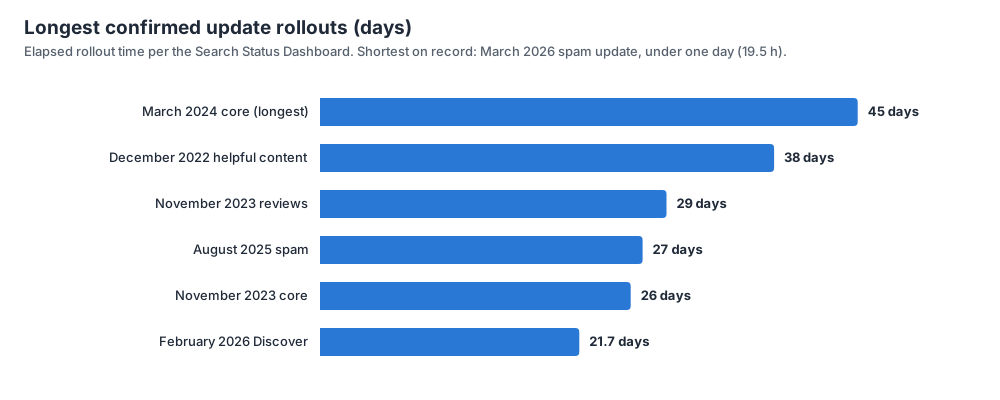
The announcement introduced a sitewide signal against what Google called a "search engine-first approach" to content, rather than writing for people. Two details made it different from anything before it. First, it was sitewide: a high proportion of unhelpful content could drag down the whole domain, which is why the announced remedy was removing unhelpful content, not adding more. Second, it was automated and continuously applied. The rollout took 15 days. A follow-up on 5 December 2022 extended it to all languages over a 38-day rollout, the second-longest on the dashboard to date.
The 2023 cadence
2023 packed nine confirmed updates into a single year, sometimes overlapping. All dates and durations below are from the Search Status Dashboard (checked 17 July 2026).
| Start | Update | Rollout |
|---|---|---|
| 21 Feb 2023 | Reviews update | 14 days |
| 15 Mar 2023 | Core update | 13 days, 7 hours |
| 12 Apr 2023 | Reviews update | 13 days, 2 hours |
| 22 Aug 2023 | Core update | 16 days, 3 hours |
| 14 Sep 2023 | Helpful content update | 13 days, 11 hours |
| 4 Oct 2023 | Spam update | 15 days, 12 hours |
| 5 Oct 2023 | Core update | 13 days, 23 hours |
| 2 Nov 2023 | Core update | 25 days, 21 hours |
| 8 Nov 2023 | Reviews update | 29 days |
The November 2023 reviews update is the last one Google announced individually. Google's reviews system documentation now states that "the reviews system is improved at a regular and ongoing pace" (checked 17 July 2026), so no per-update dates exist for it after November 2023.
March 2024: the turning point
The March 2024 core update ran from 5 March to 19 April 2024: 45 days, still the longest rollout on the dashboard. It absorbed the helpful content system into core ranking; Google's March 2024 announcement says there is "no longer one signal or system" doing that job, and the ranking-systems guide now lists helpful content as part of core. In its consumer-facing post, Google said it expected the update, combined with earlier work, to reduce low-quality, unoriginal content in results by 40%; the same post was later updated to say the eventual figure was 45% as of 19 April 2024.
Alongside it, new spam policies took effect on 5 March 2024: expired domain abuse, scaled content abuse, and site reputation abuse (the last enforced from 5 May 2024). One of these deserves a plain-spoken callout for anyone running a tools or utility site: publishing many templated pages whose text is interchangeable boilerplate is precisely the pattern the scaled content abuse policy names. The safe response is fewer pages, each saying something specific and verifiable, which is the editorial standard this site now applies to itself.
August 2024 to 2025: recovery signals and a quiet year
After a June 2024 spam update (20 June, 7 days), the August 2024 core update (15 August to 3 September, 19 days) was notable for its framing: Google said it took into account feedback heard from creators over the preceding months and aimed to better surface "small or independent sites that are creating useful, original content". Whether outcomes matched the framing is disputed among site owners, and Google publishes no site-level data either way. Separately, the dashboard logged a ranking incident starting 15 August 2024 (resolved after roughly four and a half days) which Google described as unrelated to the core update; incidents and updates are listed in different dashboard sections and should not be conflated.
The year closed with three confirmed releases in quick succession: a core update on 11 November (23 days, 13 hours), another on 12 December (6 days, 4 hours), and a spam update on 19 December 2024 (7 days, 2 hours).
Then 2025 turned quiet: four confirmed updates, the fewest of the dashboard era, as Search Engine Land's year-in-review tallied. Core updates ran 13–27 March, 30 June to 17 July, and 11–29 December; the year's only spam update ran from 26 August for about 27 days.
2026 so far (checked 17 July 2026)
Five confirmed updates as of 17 July 2026, all verified directly on the Search Status Dashboard on that date:
- February 2026 Discover update (5 February, 21 days 17 hours): the first Discover-scoped entry on the Search Status Dashboard. Per Google's announcement, it improves local relevance by country of origin, reduces clickbait, and rewards demonstrated expertise, starting with US English.
- March 2026 spam update (24 March, 19 hours 30 minutes): the fastest rollout ever logged on the dashboard.
- March 2026 core update (27 March, 12 days 4 hours): confirmed complete in early April; Google called it a regular update and published no companion post, per Search Engine Journal.
- May 2026 core update (21 May, 11 days 21 hours): Google described it as designed to surface relevant, satisfying content from all types of sites, per Search Engine Roundtable.
- June 2026 spam update (24 June, 2 days 1 hour): Google described it as a normal spam update, rolling out for all languages and locations, per Search Engine Land. This is the most recent dashboard entry as of 17 July 2026.
How often does Google ship confirmed updates?
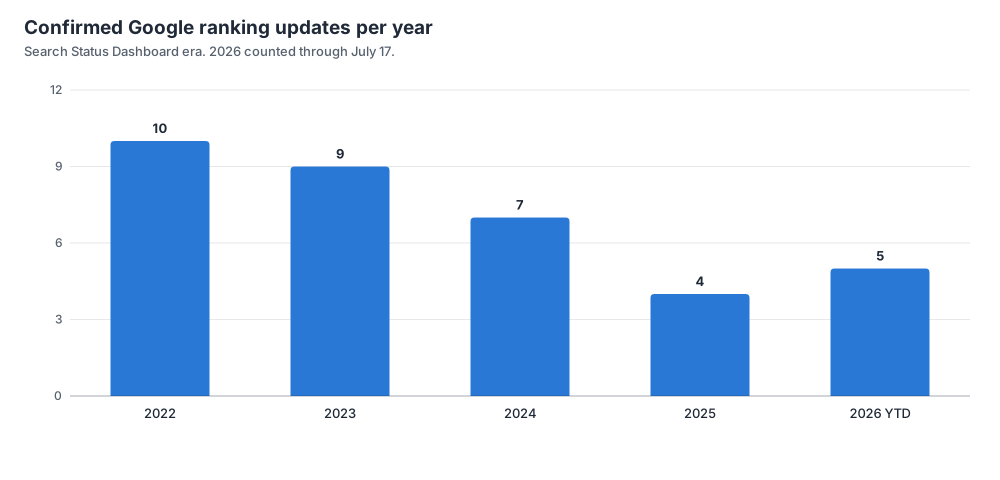
Two patterns are visible in the dashboard data. First, the confirmed cadence has slowed: from ten confirmed updates in 2022 to four in 2025. That does not mean Google changed less; unannounced adjustments happen constantly. It means fewer changes crossed Google's own threshold for a named, dashboard-logged update.
Second, rollout lengths vary enormously, from the 45-day March 2024 core update to a March 2026 spam update that finished in under a day. This is why Google's wait-a-week-after-completion advice matters: reading rankings mid-rollout means reading a moving target.
The search landscape behind the timeline
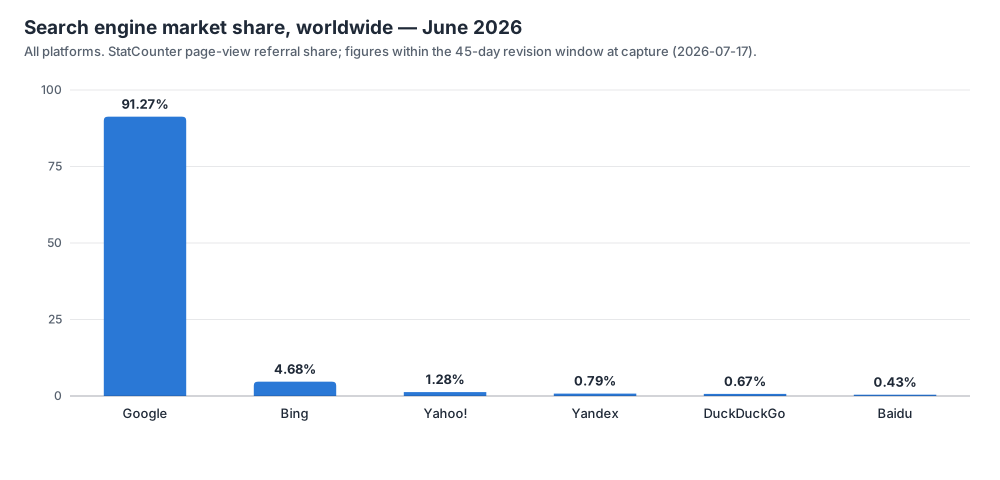
Algorithm updates matter in proportion to how much traffic actually flows through Google. Here is where that stands, using StatCounter's June 2026 data. Methodology caveat first, from StatCounter's own FAQ: these figures measure page-view referrals across StatCounter's tracked sites, with bot traffic removed, and numbers can be revised for up to 45 days after publication. The June 2026 figures below were captured on 17 July 2026, inside that revision window.
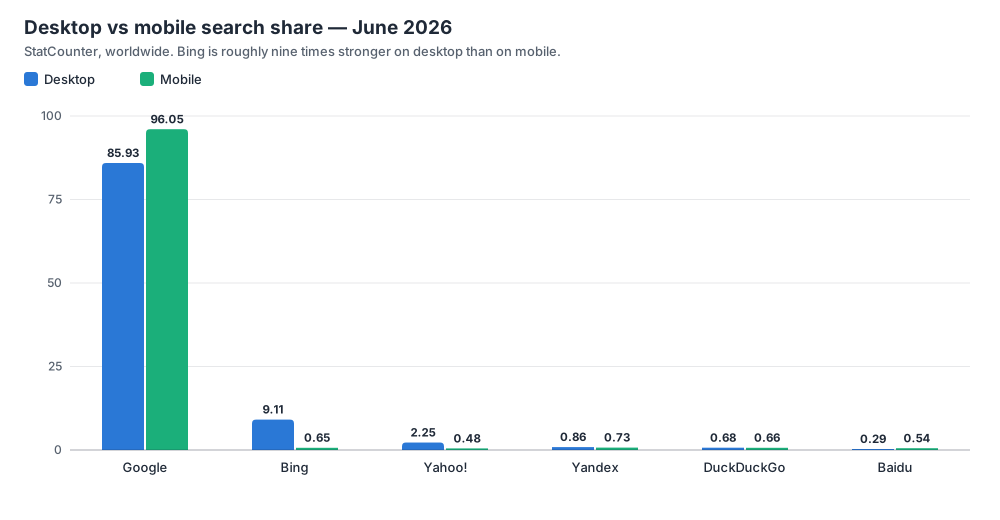
The split by device is the detail most summaries miss: Bing holds 9.11% of desktop referrals but only 0.65% on mobile, where Google's share reaches 96.05%.
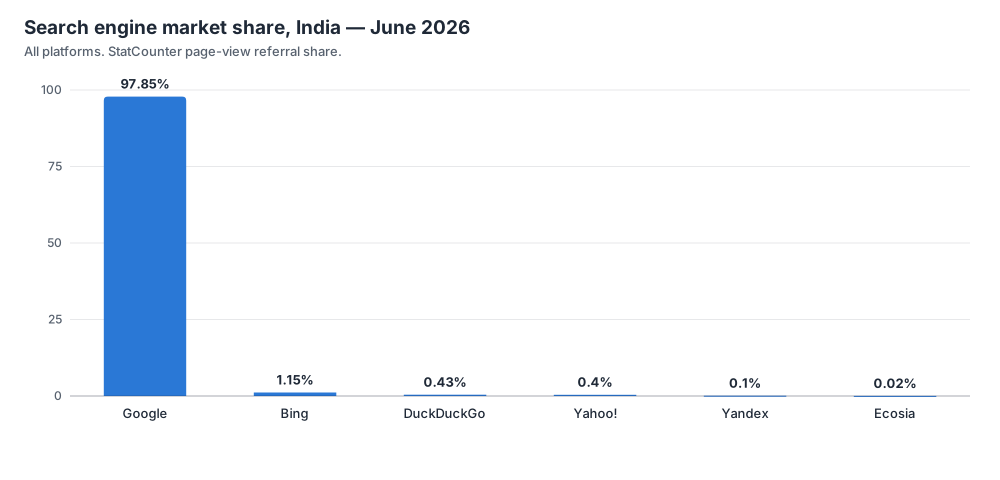
And in India, this site's home market, the picture is even more one-sided: Google at 97.85%.
The late-2024 dip, in proportion
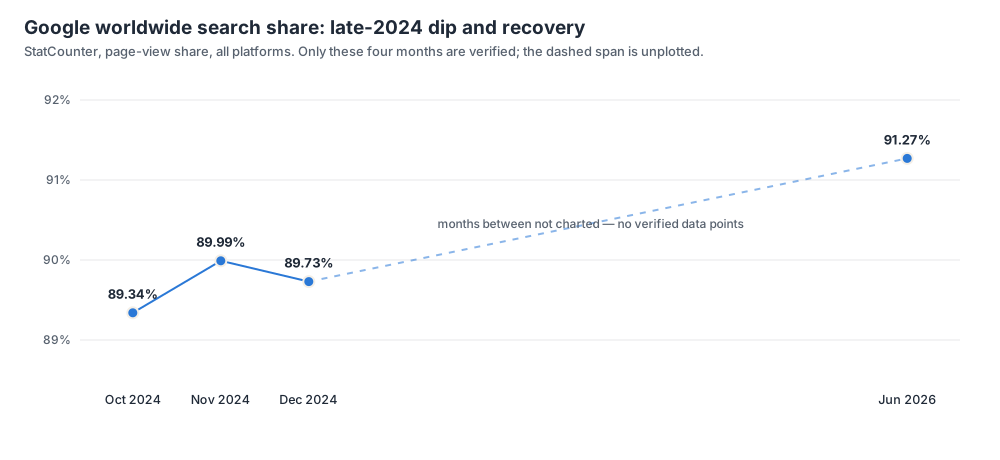
In late 2024, Google's worldwide share slipped below 90% for three consecutive months for the first time in years: 89.34% in October, 89.99% in November, 89.73% in December, with the movement concentrated in Asia, as Search Engine Land reported in January 2025. Two cautions before drawing conclusions. StatCounter does not track AI chat tools as search engines, so, as that report itself noted, the dip cannot simply be attributed to AI assistants. And the dip did not persist: by June 2026 the worldwide figure stood at 91.27%.
Where to actually submit your site
Given those shares, the practical submission map is short:
- Google: submit your XML sitemap in Search Console and reference it with a
Sitemap:line in robots.txt. Google's sitemap documentation is explicit that "a sitemap is merely a hint": submission does not guarantee crawling, and indexing is never guaranteed for any page. Build one with our XML Sitemap Generator and check your robots.txt with the Robots.txt Tester; the sitemaps guide covers the details. - Everything else, via IndexNow: a single IndexNow ping notifies Bing, Naver, Seznam, Yandex, Yep and Amazon, per the IndexNow FAQ. IndexNow is absent from Google's documented submission methods, so it does not replace the Search Console route.
- Bing punches above its weight: Bing's index also powers Yahoo, largely powers DuckDuckGo, and feeds Microsoft Start and Bing-backed AI tools, per Bing's June 2025 webmaster post. DuckDuckGo notes it also uses its own crawler and other sources, so "largely" is doing real work in that sentence.
One operational footnote: none of this helps if your server is down during a crawl or a rollout. A site returning 5xx errors cannot be crawled, whatever you submitted. A quick look with Check Server Status or Is It Down rules that out in seconds.
A live check: what a submission actually covers
Because indexing is not guaranteed, the first question after any update scare should be a boring one: what does my sitemap actually expose, and is my homepage even indexable? We ran our own Index Pages Checker against highseotools.com on 17 July 2026. The real, unedited result:
| Check | Result (17 July 2026) |
|---|---|
| Homepage | HTTP 200, indexable (no noindex) |
| robots.txt | HTTP 200 |
| Sitemap files discovered | 1 (sitemap.xml) |
| Indexable URLs listed in sitemap | 83 |
That 83 is a sitemap-based estimate of what we are asking search engines to index, not what Google has actually indexed; only Search Console shows the real indexed total, and the two numbers routinely differ. Run the same check on your own domain, then compare it against your Search Console indexing report. If the gap is large, that gap, not the latest algorithm update, is usually the first thing to fix.
Known unknowns: what this page cannot tell you
An honest reference states its limits. As of 17 July 2026:
- Older end dates are derived, not logged. For pre-2025 entries we compute end dates from the dashboard's start time plus stated duration; the dashboard did not always capture completion timestamps directly.
- June 2026 StatCounter figures may still move. They were captured inside StatCounter's 45-day revision window and can be revised.
- Absence here does not mean nothing happened. Unconfirmed volatility events are excluded by editorial policy. Google adjusts ranking constantly without announcements.
- "Medic" is an industry label. Google never characterised the August 2018 update beyond "broad core update"; the health-sector skew comes from a survey of just over 300 self-reported affected sites.
- Reviews updates are no longer datable. Google says the reviews system improves "at a regular and ongoing pace" but stopped announcing individual updates after November 2023, so no official per-update dates exist beyond that point.
- Nobody outside Google can measure an update's mechanics. Google does not disclose ranking-factor weights. Everything beyond the confirmed dates and Google's stated intent is inference.
How to use this page when the next update lands
Check the Search Status Dashboard to confirm an update is real. Wait for the rollout to finish, plus a week. Compare Search Console data before and after, per Google's method. Then audit content quality against the helpful-content questions rather than chasing a fix, because Google documents none. Every date above was verified against its source on 17 July 2026; dashboards and documentation change, so if you are reading this much later, treat the dashboard as the tiebreaker. This page will be updated when the dashboard adds entries.