What Is SEO and How Does It Work? A Beginner's Guide
SEO — search engine optimization — is the practice of improving your website so it ranks higher in search results and earns more relevant, free traffic. If you've ever wondered how some pages reach the top of Google, this beginner's guide explains how it works and how to start.
What is SEO?
SEO is everything you do to help search engines understand your content and trust it enough to show it to people searching for what you offer. Unlike ads, organic (SEO) traffic is free — you earn it by being genuinely useful and technically accessible. It compounds over time, making it one of the highest-ROI marketing channels.
How search engines work
Search engines follow three stages:
- Crawling — bots (like Googlebot) follow links to discover pages. They need to be able to reach your pages and read them.
- Indexing — discovered pages are analysed and stored in a giant database (the index). A page that isn't indexed can't rank.
- Ranking — when someone searches, the engine sorts indexed pages by hundreds of signals to show the most relevant, trustworthy results first.
Your job in SEO is to make all three easy: be crawlable, be index-worthy, and send strong relevance and trust signals.
The three pillars of SEO
1. On-page SEO
Everything on the page itself: content quality, titles, headings, keywords, and internal links. This is the part you fully control — see our on-page SEO guide.
2. Technical SEO
The foundation that lets engines crawl, render, and trust your site: speed, mobile-friendliness, security, structured data, and a clean site structure. Work through our technical SEO checklist.
3. Off-page SEO
Signals from outside your site — mainly backlinks from other trusted sites, which act like votes of confidence. Learn the safe way in our backlink guide.
How to start with SEO
- Do keyword research — find what your audience searches for (step-by-step guide).
- Create genuinely useful content that fully answers those queries.
- Optimise on-page elements — titles, meta, headings, internal links. Tools like our Meta Tag Generator and Keyword Density Checker help.
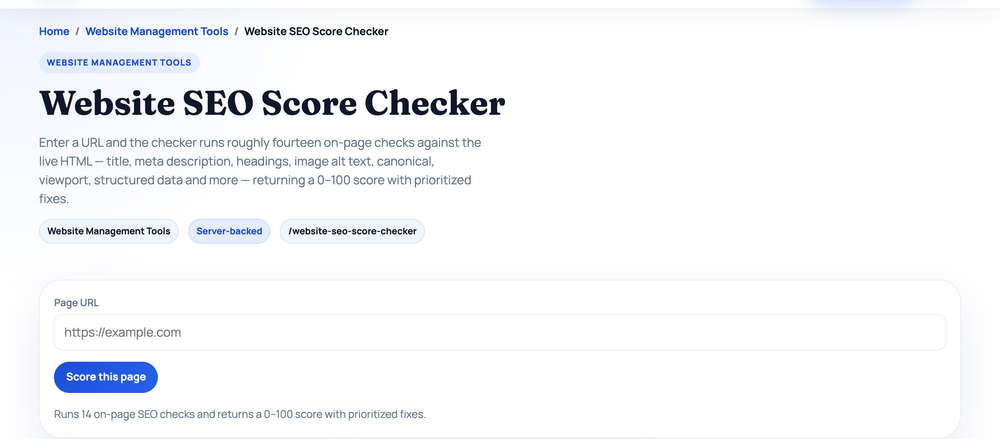
- Fix technical basics — check your site with the Website SEO Score Checker.
- Earn quality links over time and measure progress in Google Search Console.
How long does SEO take?
SEO is a long game. There is no fixed timeframe — how quickly a new site sees meaningful organic traffic depends on competition, content quality, and consistency, and progress tends to compound over time rather than arrive on a schedule. Anyone promising instant #1 rankings is selling a shortcut that doesn't exist.
White-hat vs black-hat SEO
You'll hear SEO split into two camps. White-hat SEO follows search engines' guidelines — earning rankings with useful content, a sound technical setup, and genuine links. Black-hat SEO tries to trick the algorithm with hidden text, bought links, cloaking, or spun content. Black-hat tactics can work briefly, but Google's updates are specifically built to find and penalise them, and recovering from a penalty costs far more than the shortcut ever saved. For any site you plan to keep, white-hat is the only sane choice.
How to tell whether SEO is working
SEO is invisible unless you track it, so set up two free tools from day one:
- Google Search Console — the queries you appear for, your average position, clicks, and which pages are indexed. This is your SEO dashboard.
- An analytics tool (such as Google Analytics) — how many people arrive from organic search and what they do next.
Watch the trend over months, not days. Rising impressions mean Google is showing you more often; rising clicks and positions mean your content is winning. When a page stalls, improve the page — better SEO is usually a better answer, not a trick.
Audit your first page: a step-by-step example
Here's how to apply the three pillars to a single page of your own site. Say you've published a blog post on "how to fix 404 errors" and want to check whether it's set up for search engines.
- Check on-page elements. Enter your page's title, URL, and meta description into the SERP Snippet Preview tool. Does your title tag show the keyword clearly? Is your meta description compelling enough that you'd click it in search results? Adjust title and description if they're weak or over 60 and 160 characters respectively.
- Verify keywords are present. Use the Keywords Density Checker to see which words appear most on your page. If "404 error" shows up rarely or "fix" appears more than your target keyword, rewrite a few sentences to balance keyword presence without sounding robotic.
- Test technical basics. Visit the Website SEO Score Checker and enter your page URL. It checks indexability, the mobile viewport tag, server response time, HTML size, and on-page basics in one go. A weak score in any area is your next fix — for example, a slow server response or heavy HTML payload points to speed work.
- Check if it's crawlable. Use the Spider Simulator to see your page as Googlebot does. If critical content is hidden from crawlers (behind JavaScript, for example), search engines can't read it to rank it.
That's one page optimised across all three pillars. Repeat for your top 10 pages, track the results in Google Search Console, and watch traffic trends over the following months.
Where to go from here
SEO comes down to three things: be technically accessible, publish genuinely useful content, and earn trust through quality links — patiently. Start with a free website SEO score check to see where your site stands today.
Sources and official references
Use these external references to verify the guidance and terminology in this article.
Frequently asked questions
Is SEO still worth it?
Yes. Organic search remains one of the largest, most cost-effective sources of traffic. It takes time, but the results compound and don't disappear the moment you stop paying, like ads do.
Can I do SEO myself?
Absolutely. The fundamentals — useful content, clean on-page elements, and technical basics — are learnable and free. Tools and services help you go faster, but you can start solo.
What's the difference between SEO and SEM?
SEO earns free organic rankings over time. SEM (search engine marketing) usually refers to paid search ads that appear instantly but stop when you stop paying.