How to Build Safe, White-Hat Backlinks in 2026
Backlinks remain one of the strongest ranking signals in Google's algorithm, but the rules have changed. A single relevant link from a trusted site is worth more than a hundred low-quality ones — and the wrong links can actively hurt you. This guide covers how to build backlinks the safe, white-hat way in 2026.
What makes a backlink valuable?
Not all links are equal. Search engines weigh several factors when deciding how much authority a link passes:
- Relevance — a link from a site in your niche is worth far more than an unrelated one.
- Authority — links from established, trusted domains carry more weight. You can sanity-check a domain with our Domain Strength Checker.
- Placement & context — an editorial link inside the body of a relevant article beats a footer or sidebar link.
- Anchor text — natural, varied anchors look organic; over-optimized exact-match anchors look manipulative.
- Dofollow vs nofollow — a healthy profile contains a natural mix of both.
Safe ways to earn backlinks
1. Quality directory & citation listings
Reputable, niche-relevant directories and business citations are a legitimate foundation — especially for local and new sites. Look for established, moderated directories that review submissions by hand, and skip anything that approves every listing instantly: instant approval is the clearest sign a listing passes no real value.
2. Digital PR and guest contributions
Publishing genuinely useful content on relevant industry blogs earns editorial links and referral traffic. Pitch ideas that help the host site's audience — not thinly disguised ads.
3. Create link-worthy assets
Original research, free tools, data studies, and comprehensive guides naturally attract links. (The free tools on this site are an example — useful resources people reference.)
4. Reclaim unlinked mentions
Find places that mention your brand without linking, and politely ask for a link. These convert well because the relationship already exists.
Link types to avoid
These shortcuts can trigger penalties or wasted budget. Steer clear of:
- Private blog networks (PBNs) and link farms
- Bulk "buy 1000 backlinks" packages and automated link blasts
- Irrelevant, spammy comment and forum links at scale
- Exact-match anchor text over-optimization
- Anything that promises "guaranteed #1 rankings"
If a service guarantees rankings or instant results, treat it as a red flag. Sustainable SEO is earned, not bought in bulk.
How to track your backlink profile
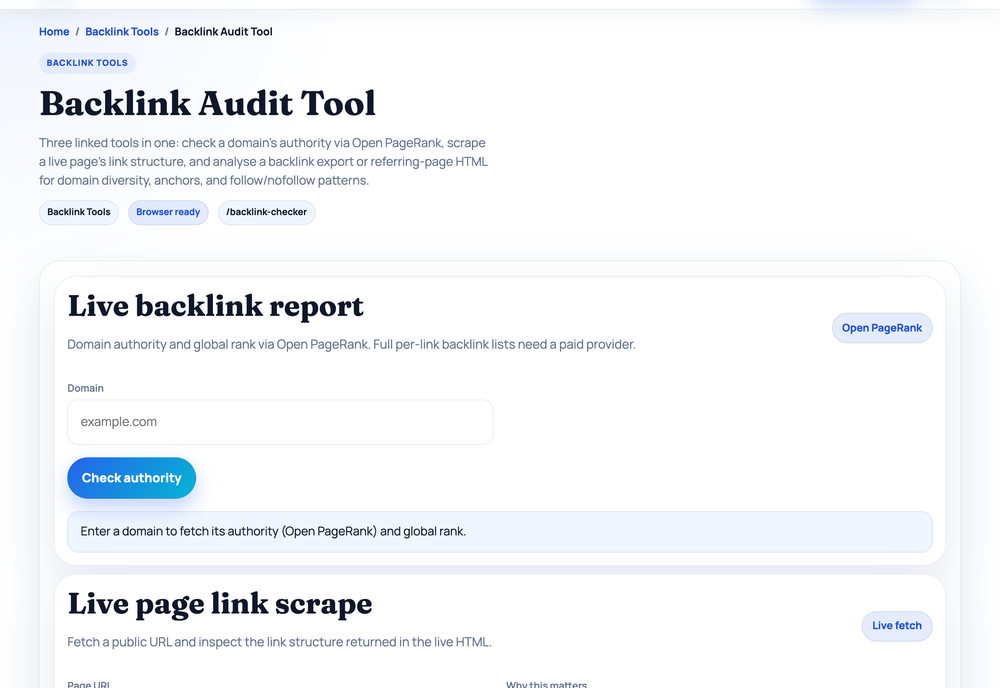
Review your referring domains and anchor-text distribution periodically. Our Backlink Audit Tool analyzes a backlink sample you paste in (or the links on a page it fetches), showing referring domains, anchor-text distribution, and the follow/nofollow balance so you can spot risky patterns early.
A simple outreach process that earns real links
Most quality links come from asking the right person with a genuinely useful reason. A process you can repeat:
- Build a short, relevant list — niche blogs, resource pages, and industry roundups that already link to content like yours.
- Find the real contact — a named author or editor, not a generic "info@" inbox. A personal email is answered far more often.
- Lead with value — point to a specific page of theirs, explain in two or three sentences why your resource genuinely improves it, and stop there.
- Follow up once, politely, after about a week — then move on. A 5–10% positive reply rate is normal, so the quality of your list matters far more than the number of emails you send.
Vet a link opportunity in 30 seconds
Before spending time chasing a link, sanity-check the source. Walk away if you see any of these:
- The site publishes unrelated, low-effort posts across a dozen unrelated niches.
- Its "write for us" page openly sells "do-follow placements".
- Outbound links point to gambling, payday-loan, or pharma spam.
- There are no real author bylines, no contact details, and no genuine audience.
The simplest test: would a real person ever reach your page through this link? If not, it is not worth your time — and a single editorial link from a respected, relevant site can outweigh fifty of these combined.
Auditing a link opportunity in practice: one site, five checks
Theory is useful, but seeing it applied to a real prospect is more practical. Imagine you've found a resource page that covers SEO tools and would be a natural fit for linking to one of your free tools. Here's how to vet it in five minutes:
- Check domain age and authority. Use our Domain Strength Checker to see if the site has credible SEO weight. A domain authority of 20+ and visible organic traffic suggest it's a real, indexed site (not a thin affiliate clone). If it shows zero authority or looks brand new, walk away.
- Read the actual page. Does it exist for readers, or just for links? Real resource pages have descriptions, screenshots, or genuine comparisons. If all you see is a list of affiliate links and thin one-liners, the site exists to manufacture links, not help people.
- Scan their outbound links. Open the page's Network tab or use Website Link Analyzer Tool to review where they send traffic. If 60%+ of outbound links point to gambling, payday loans, or unrelated affiliate niches, the site's audience is secondary to their commission structure.
- Find a named author or editor. Look for a byline, author bio, or named contact. If there's only a "contact us" form and no human name attached to the content, it signals content farms, not editorial judgment.
- Ask: would a real person click this link? If you found this page organically and thought "yes, this resource is useful for my audience," then a link from it has genuine value. If it feels like a silo of link placements, skip it. One legitimate editorial link beats fifty transactional placements.
This routine takes time only the first few times. Soon you'll recognize quality instantly — and you'll spend far fewer hours chasing low-reward prospects.
Earn links that last
Focus on relevance and quality over volume. A steady stream of safe, contextual links — backed by content worth linking to — compounds over time. Prioritise manual outreach and quality citations over bulk shortcuts, and audit what you build with the Backlink Audit Tool as you go.
Sources and official references
Use these external references to verify the guidance and terminology in this article.
Frequently asked questions
How many backlinks do I need to rank?
There's no magic number — relevance and quality matter far more than count. A handful of strong, relevant links often outperforms hundreds of low-quality ones.
Are paid backlinks safe?
Buying links that pass PageRank violates Google's guidelines. Paying for legitimate services like manual outreach, citation building, or sponsored content (with proper rel attributes) is different from buying bulk links.
How long do backlinks take to work?
It varies. Google must crawl the linking page, and ranking changes can take weeks to months. Treat link building as a compounding, long-term investment.