Anchor Text: Best Practices for Safe Link Building
Anchor text is the clickable, visible text of a link. It's a signal search engines use to understand what the linked page is about — which makes it powerful, but also easy to overdo. Here's how to use anchor text safely.
What is anchor text?
In the link "read our backlink guide", the words "backlink guide" are the anchor text. Search engines use it as a hint about the destination page's topic, so relevant, descriptive anchors help — while manipulative ones can hurt.
The main types of anchor text
- Exact-match — the target keyword exactly ("keyword density checker"). Powerful but risky in excess.
- Partial-match — a variation ("check your keyword density").
- Branded — your brand name ("HighSEOTools"). Safe and natural.
- Naked URL — the raw link ("highseotools.com").
- Generic — "click here", "read more", "this page".
- Image links — where the alt text acts as the anchor.
Why distribution matters
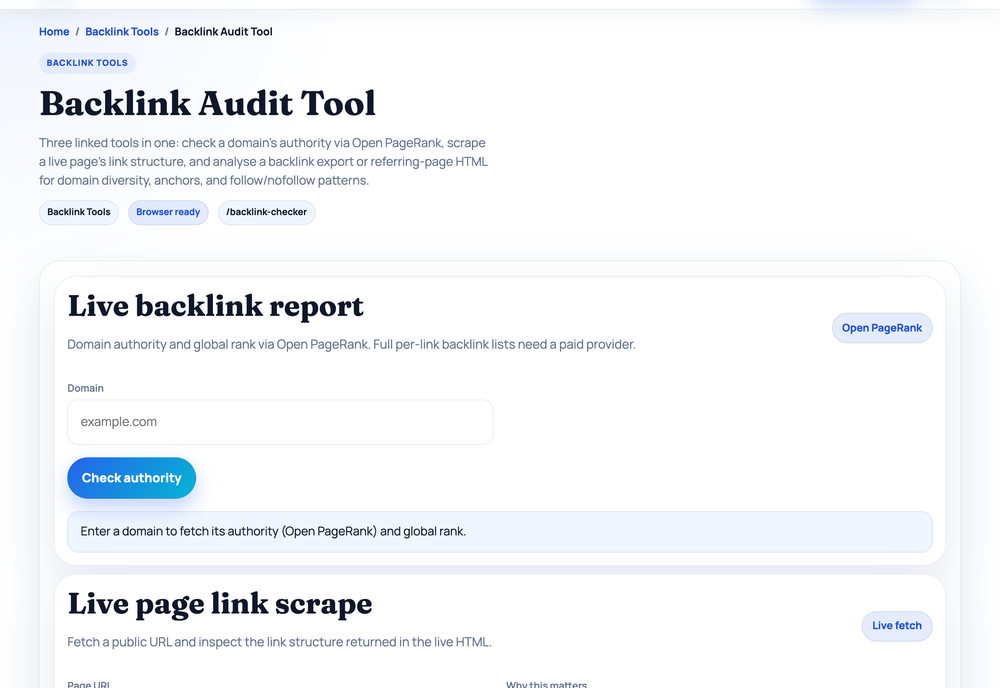
A natural backlink profile contains a mix of all these types, dominated by branded and naked-URL anchors, with only a small share of exact-match. When a site has an unnatural spike of exact-match anchors, it looks manipulated — a classic over-optimization signal that can trigger a penalty. You can review your current anchor distribution with our Backlink Audit Tool.
Over-optimization: the risk
After Google's Penguin updates, aggressive exact-match anchor building became one of the fastest ways to get penalised. The lesson: never force the same keyword anchor across many links. Let anchors vary the way real, editorial links naturally do.
Best practices
- Favour branded, naked-URL, and natural-phrase anchors.
- Keep exact-match anchors rare and only where genuinely relevant.
- Make anchors descriptive and useful to the reader first.
- Don't control anchors on links you didn't place — natural links use varied text, and that's good.
- Match the anchor to the destination page's actual topic.
Internal vs external anchors
You have full control over internal anchors (links between your own pages) — use clear, descriptive text to help users and spread relevance, as we do throughout this blog. For external links pointing to you, focus on earning relevant links from quality sites and let the anchors fall naturally. See our safe backlink guide.
What a natural anchor profile looks like
There's no official ratio, but profiles built from genuine, editorial links tend to look similar: the largest share is branded and naked-URL anchors (people link using your name or paste your URL), a meaningful chunk is generic or partial-match ("this guide", "a useful keyword tool"), and only a small slice is exact-match. You don't engineer this distribution directly — you earn it by getting links from varied sources who each describe you in their own words. If a backlink audit shows a sudden spike of identical exact-match anchors, that's the signal to investigate.
What to do if your anchors look over-optimised
If you (or a previous SEO) built too many exact-match anchors, don't panic — and don't try to "balance" them by mass-building more. Dilute the profile naturally over time by earning fresh links with varied, branded anchors, and review whether any of the aggressive links come from genuinely spammy sites. Links you can't get removed from truly toxic sources can be disavowed as a last resort, but for most sites, simply earning more natural links restores a healthy balance on its own.
Spotting over-optimization: a sample backlink audit
Suppose a site selling productivity tools ran an aggressive link-building campaign around the phrase "time management software"—and now 58% of its backlinks use that exact anchor. Here's how to spot and act on that:
- Pull the backlink report. Paste your backlink export into the Backlink Audit Tool and review the anchor-text distribution it builds. You'll see columns for anchor text, count, and percentage of total links.
- Calculate the red flags. In this example: 580 exact-match anchors out of 1,000 total backlinks = 58%. Compare to a healthy profile: typically 60–75% branded + naked-URL, 15–25% generic or partial-match, and only 5–10% exact-match.
- Identify the sources. Group the 580 exact-match links by referring domain. If most came in a 3-month window from similar-quality directories or comment sections, that confirms manipulation.
- Plan your recovery. Don't delete good links or mass-disavow. Instead, focus on earning new links with branded anchors ("productivity tools by [Brand]"), partial matches ("this time management guide"), and generic text ("found this useful"). With natural link growth over time, a 58% share would gradually dilute toward a safer range.
- Monitor progress. Re-run the Backlink Audit Tool quarterly to verify the ratio improves and watch for any new suspicious patterns.
The key insight: you're not trying to engineer a perfect distribution—you're earning fresh, varied links that naturally push the aggressive anchors into the background, where they belong.
Anchors that age well
Anchor text is a real ranking signal, but the winning strategy is restraint: natural, varied, descriptive anchors — heavy on branded, light on exact-match. Audit your profile with the Backlink Audit Tool and keep it looking organic.
Sources and official references
Use these external references to verify the guidance and terminology in this article.
Frequently asked questions
What is the ideal anchor text ratio?
There's no exact formula, but natural profiles are dominated by branded and naked-URL anchors, with exact-match kept to a small minority. Aim for variety that looks editorial, not engineered.
Can anchor text cause a penalty?
Yes. An unnatural concentration of exact-match keyword anchors is a known over-optimization signal that can trigger algorithmic penalties. Keep anchors varied and natural.
Does internal anchor text matter?
Yes — internal links are fully in your control, and descriptive anchor text helps users and helps search engines understand your pages. Just keep it natural, not stuffed.