
What Is Domain Authority (DA) and How to Improve It
Domain Authority (DA) is a score from 0 to 100, invented by the SEO software company Moz, that estimates how likely a website is to rank in search results based on the links pointing at it. Google does not use it — DA and its rival metrics are third-party estimates, genuinely useful for comparing sites and tracking your own trend, and this guide explains how to read them without being misled.
Part 9 of 12 in the HighSEOTools SEO learning path.
Links as votes: the idea behind the score
A backlink is a link from a page on someone else's website to a page on yours. Search engines have always treated backlinks as something like endorsements: Google's original breakthrough, an algorithm called PageRank, ranked pages partly by counting these votes and weighting each one by the authority of the voter — a link from a trusted, much-linked site counts for more than a link from an obscure one.
Google keeps its modern link calculations private, so SEO tool companies built their own approximations. Each one crawls (systematically downloads) as much of the web as it can afford, maps who links to whom — the link graph — and compresses every domain's position in that graph into a single number. Moz calls its number Domain Authority; Ahrefs calls its own Domain Rating (DR); Semrush has Authority Score; Open PageRank publishes a free 0–10 score. Different crawls, different formulas — which is why the same site can be "DA 40" in one tool and "DR 55" in another, and why a score is only ever comparable to other scores from the same tool.
Whatever the brand name, two inputs dominate: how many different websites link to you — referring domains, counted once per site no matter how many individual links it sends — and how authoritative those linking sites themselves are. One link each from fifty relevant sites generally signals more than fifty links from one site.
DA is not a Google ranking factor
This is the single most important fact about authority scores: Google does not use Moz's DA, Ahrefs' DR, or any other third-party metric in its ranking systems. It cannot — these numbers are outside companies' estimates of a signal Google computes for itself, from its own far larger crawl. A site can raise its DA with manipulative links and gain nothing in Google, because Google never sees the number, only the links. Treat authority scores as a speedometer built by someone who has never seen your engine: directionally useful, never authoritative.
Reading a real score, field by field
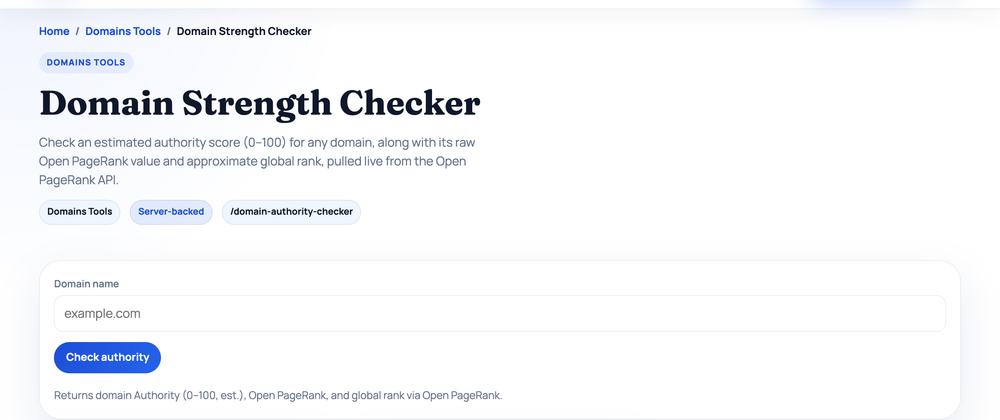
Our Domain Strength Checker accepts up to six domains at once and returns an authority estimate for each, side by side. Under the hood it queries Open PageRank — a free, public link-graph metric — and multiplies its 0–10 value by ten to give the familiar 0–100 scale. Here is the true record it returned for wikipedia.org (checked 2026-07-17):
Domain                 wikipedia.org
Open PageRank (0–10)   5.54
Authority (0–100 est.) 55
Global rank            #1,010
Data source            Open PageRank (domcop.com)
Last updated           28th Mar 2026
Each field teaches you something about how these metrics behave:
- Authority 55 is just Open PageRank 5.54 rounded and scaled. There is no extra magic in the 0–100 number — it exists because people are used to that scale.
- Global rank #1,010 places the domain among all domains in the provider's dataset, and it is often more informative than the score itself: two sites can share "55" while sitting thousands of rank positions apart.
- Last updated is why scores drift. The provider recomputes the whole graph when it re-crawls the web, so your number can move a point or two while you did nothing at all. Judge trends over months, not week-to-week wiggles.
What 507 well-known domains actually score
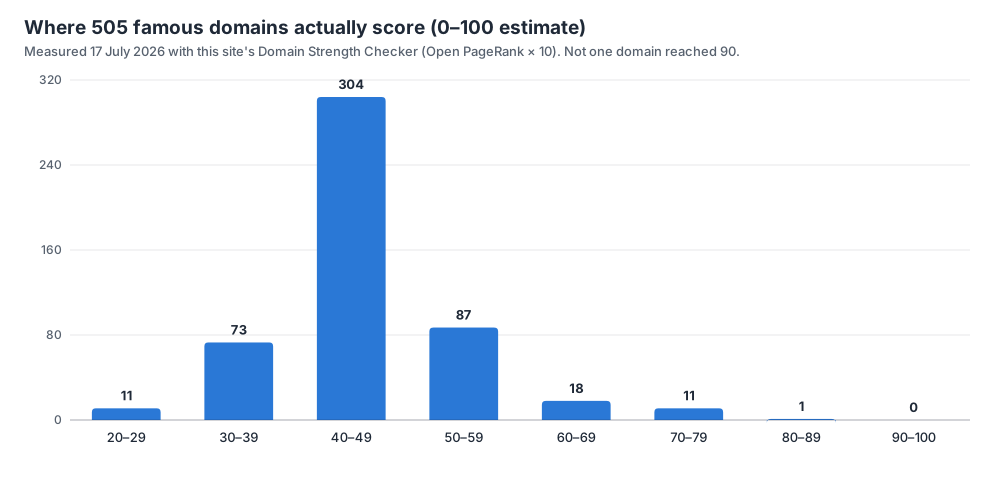
Ranges stay abstract until you see real numbers. On 3 July 2026 I ran 89 recognisable domains through this site's own Domain Strength Checker and the distribution surprised me; on 17 July 2026 I scaled the same experiment to 507 domains so the pattern could not be an artefact of a small sample. The sample covers 14 categories of 36 domains each — global platforms, news, e-commerce, SaaS, universities, governments, finance, travel, health, entertainment, sports, the SEO industry itself, web publishing, and marketplaces — plus this site's own three domains as an honest control. Every measurement went through the same public tool any visitor can use (Open PageRank × 10, in batches of six, roughly four minutes end to end), and the full result is downloadable as a 507-row CSV so you can check any number in this section yourself.
| Score band | Domains (of 507) | Examples from the sample |
|---|---|---|
| 80+ | 1 | x.com (81) |
| 70–79 | 11 | GitHub (78), Instagram (78), Facebook (76), WordPress.org (76), YouTube (74), LinkedIn (70) |
| 60–69 | 18 | Google (63), Stack Overflow, Slack, Zoom |
| 50–59 | 87 | Amazon (59), Microsoft (58), Moz (58), Ahrefs (58), Wikipedia (55), Apple (52), The New York Times (52) |
| 40–49 | 304 | MIT (48), SmallSEOTools (48), BBC (47), Semrush (46), NASA (45), Harvard (40) |
| 26–39 | 84 | Search Engine Journal, Zomato, Screaming Frog |
| No data | 2 | highseotools.com, imageconvertertool.com (both registered in 2026) |
Four things stand out, and the bigger sample makes each one harder to dismiss.
Nobody scores 90. Not one of 507 domains — not Google, not Amazon, not a national government — reached the 90–100 band that SEO folklore assigns to famous brands. Exactly one domain broke 80 (x.com, at 81). If a tool or a guest-post seller quotes you a “DA 90” site, the number is coming from a different metric, a different scale, or thin air.
The median famous brand scores 45. Half of the best-known websites on earth sit at 45 or below on this scale, and 304 of the 505 domains with data — sixty percent — are packed into the 40–49 band alone. A “mid” score does not mean a site is mid: it is where the BBC, NASA, MIT and most national newspapers live.
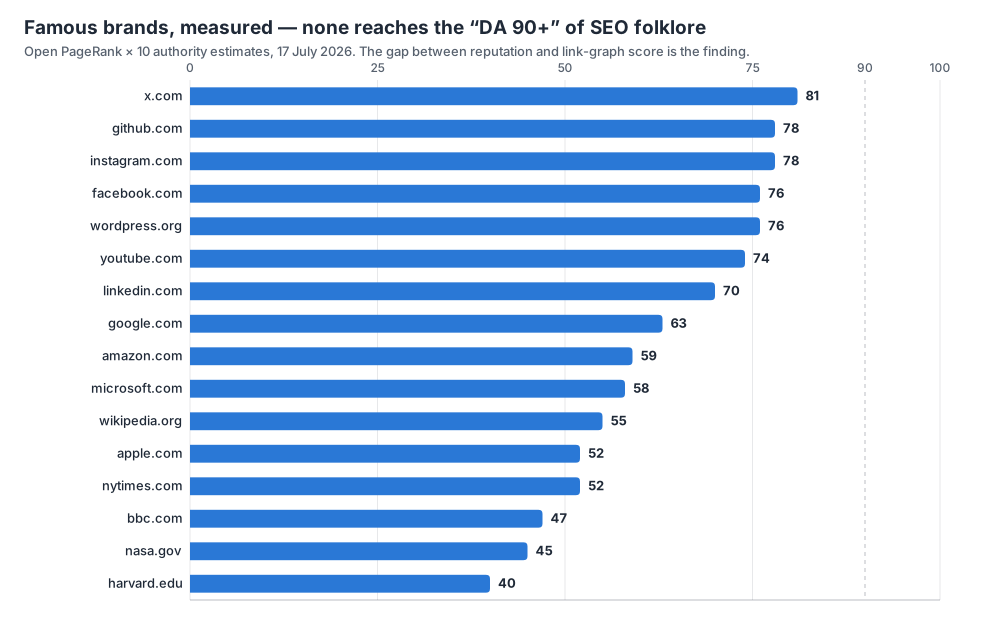
The score measures link-graph presence, not prestige. Harvard measured 40 — two points below jsonviewertool.com (42), a small single-purpose tool site we run. That is not a verdict on Harvard; it is a demonstration that Open PageRank counts how a domain sits in the crawled link graph and nothing else. Google.com itself scored 63 while GitHub and Instagram scored 78: platforms whose links are spread across millions of diverse referring pages outrank a brand whose gravity is concentrated. Read every authority metric this way — as a link-graph summary, never a quality ranking.
Category barely matters. The median by category spans only 41.5 (travel) to 50.5 (global tech and SaaS) — nine points across fourteen industries. Where a site sits inside its category matters far more than which category it is in.
The honest control did not change: highseotools.com and imageconvertertool.com, both registered in 2026, still return no data at all — the normal experience for young domains, and the reason a “no score” result from the checker is not a defect. The July 3 sample of 89 had a median of 49 against 45 here; that gap is sample composition (the larger set adds more mid-size sites), not two weeks of drift. The plan is to re-run this measurement quarterly against the same 507-domain list and publish how the distribution moves.
What actually moves the score
Because the inputs are links, the levers are link-shaped. There is no trick that raises authority directly — only work that changes your link graph:
- Earn links from relevant, trusted sites. This is the dominant lever. A handful of links from sites in your own topic tends to do more for both the score and your actual rankings than piles of unrelated ones — our guide to building safe backlinks covers how to earn them without risking a penalty.
- Publish work worth citing. Original data, genuinely useful tools, and clear explanations are what other sites link to unprompted. The 89-domain table above exists partly for that reason.
- Stay technically reachable. A link can only be counted if the crawler that builds the link graph can fetch both ends. The crawlability work from Part 3 protects your links' value; the Website SEO Score Checker gives a quick 19-check read on any URL.
- Prune spam you attract. Every site accumulates junk links over time. Export your links from Search Console (Part 11 shows where) and paste the export into the Backlink Audit Tool to spot patterns worth investigating.
All of this compounds slowly. Authority reflects years of accumulated links, so it moves on the timescale links are earned — no tool, tactic, or spend can guarantee a particular score or a particular ranking.
Measuring your own site's authority in 4 steps
Rather than guess where you stand, run a quick audit. Here's the approach we use internally on highseotools.com:
- Get your baseline. Visit our Domain Strength Checker and enter your root domain. Note the authority estimate and global rank. This is your north star.
- Audit your backlink profile. Paste a backlink export (from Search Console or any provider) into the Backlink Audit Tool and review it for spammy or irrelevant inbound links. Flag anything from unrelated niches or obvious low-quality sources. These drag your score down even if your other links are solid.
- Count quality vs. noise. In your results, mentally sort links by relevance. If most come from topically related domains, you're in good shape. If most are random directories or old blog networks, that's the real problem — not the raw count.
- Compare with page-one competitors. Run the Strength Checker on 3–5 sites that actually rank for your target keywords (it compares up to six side by side). If they cluster around 28–38, that's your realistic benchmark — not 80, which the table above shows almost nobody reaches. Focus on earning a few quality links each month instead of chasing the number.
Three ways people get burned by DA
- Treating it as the goal. Inflate DA with spammy links and you can win the number while losing rankings — Google never sees DA at all, only the links behind it.
- Comparing across tools. A Moz DA, an Ahrefs DR, and an Open PageRank estimate are three different models of three different crawls. Only compare figures from the same provider, measured around the same time.
- Ignoring the page. Authority is a domain-wide summary, but rankings happen page by page. A strong domain can still have weak individual pages; relevance and on-page quality decide which page actually ranks.
Treat DA as a compass, not a destination: watch your trend against direct competitors, and put the actual work into links, content, and technical health.
Next in the learning path: authority is a global, whole-web signal — but if your business serves a specific city or area, a largely separate ranking system decides whether you appear in the map results, and it can matter far more than any authority score. Continue with Part 10: local SEO.
Sources and official references
Use these external references to verify the guidance and terminology in this article.
Frequently asked questions
Is a higher Domain Authority always better?
Generally a higher score signals a stronger backlink profile, but it's a comparative metric. Relevance to your niche and the quality of individual pages matter more for actual rankings.
How fast can I increase DA?
Authority grows slowly and compounds. Expect meaningful movement over months of consistent link building and content work, not days.
Does Google use Domain Authority?
No. DA is a third-party metric. Google uses its own signals. DA is best used to compare sites and track your own trend over time.