Two near-identical intros
Input: Text A and Text B both contain "our handmade candles are poured in small batches".
Output: A high similarity percentage, with phrases like "handmade candles are" and "poured in small" listed as matches.
Text Compare puts two blocks of text you paste side by side, scores how similar they are as a percentage, and lists the exact three-word phrases they share — entirely in your browser.
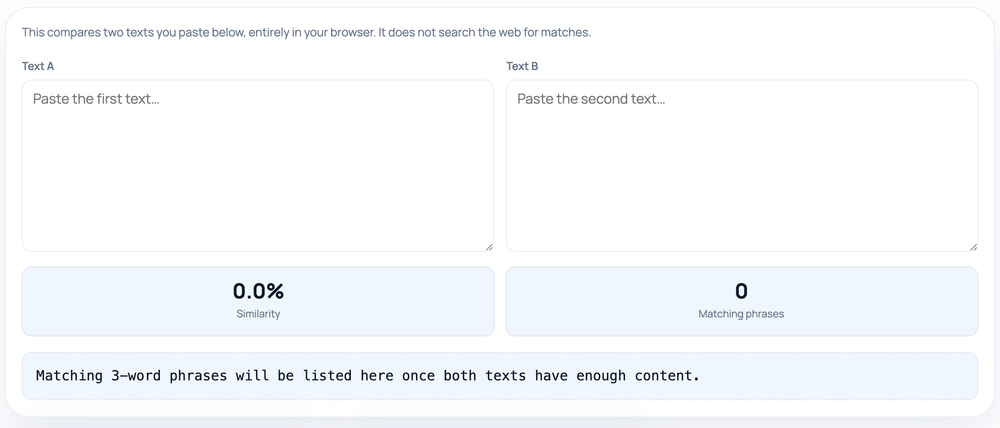
Pro tip: It only compares the two pasted blocks in your browser; it never searches the web for matches.
This is the part to be clear about: the checker looks at Text A against Text B and nothing else. It does not crawl the web, query a search engine, or hold a database of published articles, so it cannot tell you whether either passage appears somewhere online.
If you need true plagiarism detection against the public internet, this is not that tool — and it does not pretend to be. What it does well is measure how much two pieces you already have in hand resemble each other, which is a genuinely useful and very different job.
Each text is lower-cased, stripped of punctuation, and split into overlapping three-word phrases (a technique called shingling). The tool then compares the set of phrases from Text A with the set from Text B and reports two numbers: a similarity percentage and a count of matching phrases.
The percentage is a Jaccard score — the number of phrases the two texts share divided by the total number of distinct phrases across both. So if the texts have a lot of overlap relative to their combined size, the score is high; if they are mostly different, it is low. Because matching happens after case and punctuation are normalised, "Free Shipping!" and "free shipping" line up as the same phrase. The matching three-word phrases themselves are listed underneath so you can see exactly where the overlap is.
Two numbers appear: Similarity (a percentage) and Matching phrases (a count), followed by up to fifteen of the shared three-word phrases. A near-zero score means the texts barely overlap; a score climbing toward 100% means large stretches are identical word-for-word. Because the score is set-based, a short text that is fully contained in a much longer one will not read as 100% — the longer text adds many phrases the short one lacks, which lowers the ratio.
Heavy paraphrasing slips past it, because reworded sentences no longer share the same three-word sequences. It also has no opinion on which text came first or who wrote it; it only reports that phrases are present in both. Treat the score and the matches as a prompt to review, not proof of copying.
Both texts are compared on your own device. Nothing you paste is uploaded or stored, and the comparison is discarded when you close or refresh the page, so it is safe to use on unpublished drafts and client work.
Input: Text A and Text B both contain "our handmade candles are poured in small batches".
Output: A high similarity percentage, with phrases like "handmade candles are" and "poured in small" listed as matches.
Input: Text A: "We pour candles by hand." Text B: "Candles here are hand-poured in small lots."
Output: A low score with few or no matching phrases, because the wording differs even though the meaning is close.
Input: Text A is one sentence; Text B is a 500-word article that contains that sentence verbatim.
Output: Far below 100%, because Text B adds hundreds of phrases Text A does not have, which lowers the ratio.
No. It only compares the two blocks you paste; it never searches the web or any external database.
Not against published sources. It measures overlap between your two inputs only, which is a different job from web-wide plagiarism checking.
It splits each text into overlapping three-word phrases and divides the number of phrases both texts share by the total number of distinct phrases across both — a Jaccard similarity score.
The score is set-based. If one text is longer, it contributes extra phrases the other lacks, so even a verbatim passage inside a longer document scores below 100%.
Usually not. Because it matches three-word sequences, changing even one word per window breaks the match, so rewritten text tends to score low.
No. Both texts are compared in your browser and are discarded when you leave or refresh the page.
I document how each check works, where its data comes from, and which parts are only estimates.