A short, plain passage
Input: The cat sat on the mat. It was a warm day.
Output: Reading Ease near 100, labeled "Very easy"; Grade Level around 1 — short sentences, one-syllable words.
Few syllables per word pushes Reading Ease toward its ceiling.
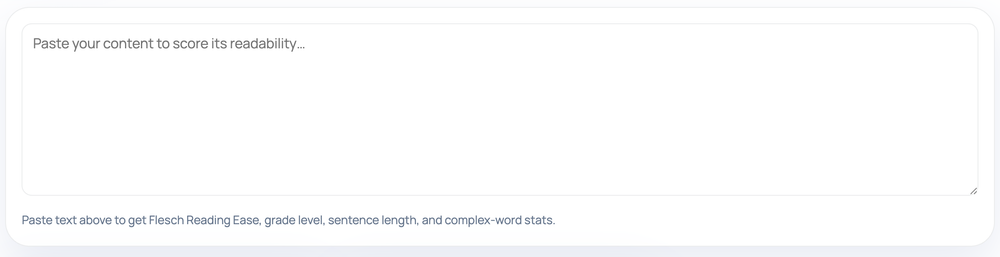
Paste text and the checker computes Flesch Reading Ease and Flesch–Kincaid Grade Level, plus average sentence length, syllable counts, the share of complex words, and an estimated reading time — with a plain-English label for the score.
Pro tip: Aim for a Reading Ease of 60+ (about 8th grade); shorter sentences and simpler words raise the score.
Readability formulas estimate how hard a passage is to read from two surface signals: how long the sentences are and how many syllables the words carry. Flesch Reading Ease returns a number from roughly 0 to 100, where higher is easier — about 60 to 70 reads comfortably for a general audience. Flesch–Kincaid Grade Level converts the same signals into a US school grade, so a score of 8 suggests an eighth-grade reading level. The two are related views of the same underlying counts.
Alongside the numbers, the tool shows a plain-language label for the Reading Ease score — for example "Standard (8th–9th grade)" or "Difficult (college)" — so you can interpret the figure at a glance without memorizing the bands.
Reading Ease is 206.835 minus 1.015 times the average words per sentence minus 84.6 times the average syllables per word. Grade Level is 0.39 times words per sentence plus 11.8 times syllables per word minus 15.59. Both hinge on counting sentences, words, and syllables. Sentences are detected by terminal punctuation (. ! ?), and syllables are counted by a vowel-grouping heuristic that handles common silent-e and -ed endings — fast and close, but not perfect on unusual spellings. That heuristic is the main reason two readability tools can report slightly different numbers for the same text.
Treat the checker as a revision aid, not a grading machine. If the Reading Ease is lower than you want for the audience, the two most effective moves are splitting long sentences and swapping a few multi-syllable words for plainer ones — both directly lower the inputs the formula reacts to. The words-per-sentence figure is the fastest lever: a single run-on sentence can drag a whole passage's score down. The complex-word percentage points you at the vocabulary side; if it is high, scan for jargon a general reader might stumble over.
Match the target to the reader. Marketing and general web copy usually aim for 60+ Reading Ease, while technical documentation written for specialists can sit lower without being wrong.
These formulas count structure, not meaning. A passage of plausible-sounding nonsense can score as easy, and rephrasing a clear sentence just to nudge the grade down can hurt clarity. They also do not judge organization, accuracy, or tone — a well-scored page can still be poorly argued. Use the numbers as a sanity check that flags overlong sentences and dense vocabulary, not as a target to game. The calculation runs entirely in your browser on the text you paste, so nothing is uploaded, stored, or sent anywhere.
Input: The cat sat on the mat. It was a warm day.
Output: Reading Ease near 100, labeled "Very easy"; Grade Level around 1 — short sentences, one-syllable words.
Few syllables per word pushes Reading Ease toward its ceiling.
Input: The implementation necessitates comprehensive evaluation of multifaceted organizational dependencies.
Output: Reading Ease in the single digits to low teens, labeled "Very difficult"; Grade Level well above 13; complex-word share very high.
Long words with many syllables and no sentence breaks drive the difficulty up.
For a broad web audience, roughly 60 to 70 reads comfortably. Technical or specialist writing can sit lower without being wrong; the right target depends on who you are writing for. The on-screen label helps you judge the band.
Because syllable counting and sentence detection use heuristics, and small differences in how abbreviations or hyphenated words are handled shift the totals. Expect minor variation between calculators.
As a word of three or more syllables. The percentage of such words is a quick proxy for vocabulary load, though some long words are still familiar and easy.
From the word count and a typical silent reading speed of about 200 words per minute. It is an average, so a careful or skimming reader will land above or below the figure.
They are two scales over the same counts. Reading Ease is a 0–100 number where higher is easier; grade level maps to a US school year. Use whichever is easier for your team to act on.
No. The scoring runs in your browser on the text you paste. Nothing is uploaded or stored, so it is safe for unpublished drafts.
Our editorial and data-source notes explain how each check works and where estimates come from.