Website Management Tools

GEO Checker

A heuristic AI-citation readiness score: it evaluates the structure and specificity that may make a page or passage easier for AI systems like ChatGPT, Perplexity, and Google AI Overviews to extract, understand, and quote — with transparent checks and AI-written fixes where available. The score does not predict whether any system will cite the page.

Website Management ToolsServer-backed/geo-checker
Step by step

How to use the GEO Checker

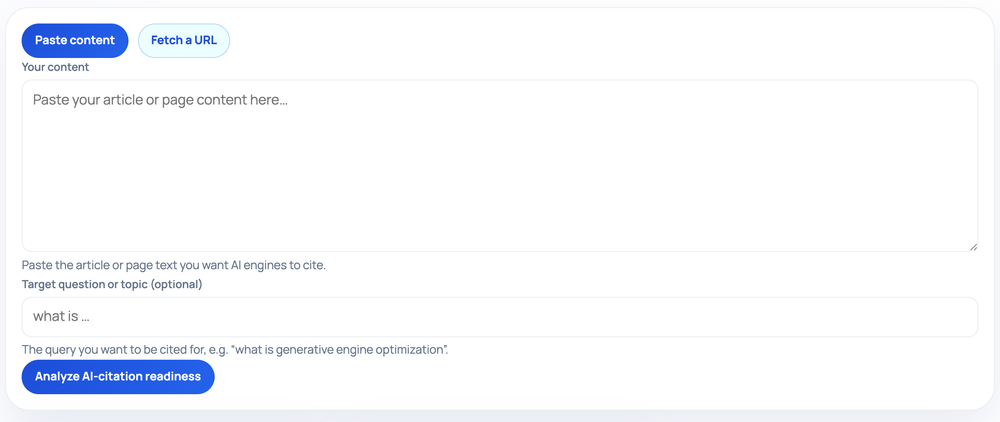
  1. Choose Paste content or Fetch a URL, then enter your article text or page URL
  2. Optionally type the target question or topic you want AI engines to cite
  3. Click Analyze AI-citation readiness to score structure and specificity
  4. Review the GEO score, citability signals, and recommended fixes including a citable rewrite
How to use the GEO Checker — tool screenshot
The GEO Checker on HighSEOTools

Pro tip: Add concrete stats, list items, and question-style headings; fact-dense, well-structured passages get pulled into AI answers far more often.

What GEO means here

GEO — Generative Engine Optimization — is about being quotable by AI answer engines, not just rankable in a classic list of blue links. When a system like ChatGPT, Perplexity, or Google's AI Overviews builds an answer, it pulls short, self-contained passages from sources it trusts and attributes them. This checker reads your page or text and scores the traits those systems tend to reward: a direct answer up front, clear structure, short sentences, and concrete, checkable facts.

You can paste content directly or give it a URL, in which case it fetches the page and extracts the visible text and headings first. There is also an optional field for the target question or topic you want to be cited for, which sharpens the qualitative feedback.

How the score is calculated

The 0–100 readiness score comes from eight transparent, deterministic checks — no black box. Each check either passes or fails and carries a fixed weight, and the panel shows you exactly which ones passed. The checks and their weights are: content depth of at least 300 words (18), at least two headings (14), an answer-first opening where the first sentence is 30 words or fewer (14), an average sentence length of 25 words or less (12), at least two list or numbered items (12), at least one question-style heading (12), at least three numbers or statistics (12), and a clear definition near the top (6).

Because the rules are fixed, two runs of the same text always produce the same score, and you can see precisely what to change to move it. Markdown headings (lines beginning with #) and bullet or numbered lines are recognised in pasted text, so structure counts even without HTML.

What the signals mean

  • Answer-first opening — does the first sentence answer the question directly, instead of warming up?
  • Structure — enough headings, including at least one phrased as a real question users ask.
  • Scannable lists — bullet or numbered items, which AI engines lift cleanly.
  • Specificity — concrete numbers, dates, and data rather than vague claims.
  • Readable sentences — an average under ~25 words, so individual statements are quotable.
  • Depth and definition — enough substance, with the topic defined plainly near the top.

AI-written feedback (when enabled)

On top of the heuristic score, the tool can add qualitative feedback written by a language model when the site has a Cloudflare Workers AI binding configured. When that is available you also get a short list of strengths, the issues holding the content back, concrete fixes, and a one-to-two-sentence rewritten passage crafted to be quoted verbatim. When the AI binding is not present, the deterministic score and signals still work on their own, and the tool simply notes that the AI layer is off — so the core analysis never depends on it.

How to act on the result

  • Lead with the answer: rewrite the opening so the first sentence resolves the query in under 30 words.
  • Add a plain definition early — a clear "X is …" sentence near the top.
  • Break dense paragraphs into bullet or numbered lists where it reads naturally.
  • Swap vague phrasing for concrete numbers, dates, and named specifics.
  • Tighten long sentences so the average drops below ~25 words.
  • Turn one or two headings into the exact questions your audience types.

Privacy and limitations

Analysis runs on the server, not in your browser: pasted text or a fetched page is sent to the endpoint to be scored, and when AI feedback is enabled a truncated copy of the content is passed to the language model to generate suggestions. Avoid pasting confidential material you would not want processed. On limits — no tool can promise an AI engine will cite you. These platforms are opaque, change often, and weigh source trust and freshness in ways no external checker can see. The score reflects well-established citability best practices, not a guaranteed outcome, and the URL mode reads server-rendered text, so content added later by JavaScript may be missed. A very long page is truncated before the AI step to keep responses fast.

Worked examples

Sample runs, start to finish

A long reference article (URL mode)

Input: https://en.wikipedia.org/wiki/Search_engine_optimization

Output: GEO readiness 56/100 · 6,072 words · 17 headings · 0 list items · 565 numbers · avg 12 words/sentence · passes depth, headings, sentence length and statistics; fails question-style headings, lists, answer-first opening and clear definition

Measured 2026-07-17. Depth and specificity are not the problem here — a long, dense page can still score mid-range because it never leads with a short, self-contained answer. Scores shift as the page is edited.

A short, direct page (URL mode)

Input: https://www.iana.org/help/example-domains

Output: GEO readiness 58/100 · 176 words · 2 headings · 0 list items · 5 numbers · avg 20 words/sentence · passes headings, answer-first opening, sentence length, statistics and clear definition; fails content depth, lists and question-style headings

Measured 2026-07-17. A 176-word page narrowly out-scores the 6,000-word article above because it answers directly and defines its topic in the opening — a useful reminder that length alone does not drive this score.

FAQ

GEO Checker — questions & answers

Will a high score guarantee AI engines cite my page?

No. AI platforms are opaque and change frequently. The score reflects citability best practices, not a promise of being quoted.

How is the score calculated?

From eight fixed, weighted checks — depth, headings, answer-first opening, sentence length, lists, question headings, statistics, and a clear definition — so the same text always scores the same.

What is the difference from normal SEO?

Classic SEO targets ranking in a results list; GEO targets being selected and quoted inside an AI-generated answer, which rewards clear, specific, self-contained passages.

Can I check a live page instead of pasting text?

Yes. Switch to URL mode and the tool fetches the page and extracts its visible text and headings before scoring.

Does it use AI to score?

The 0–100 score is fully deterministic. Separate AI-written strengths, fixes, and a citable rewrite appear only when a Cloudflare Workers AI binding is configured; otherwise the heuristic analysis runs on its own.

How much content do I need to analyse?

At least about 40 words. For a meaningful read aim for 300+ words, since content depth is one of the scored signals.

Is my content kept private?

Analysis runs server-side, and when AI feedback is on a truncated copy is sent to the language model, so avoid pasting confidential material you would not want processed.

Site standards

How HighSEOTools handles data and methodology

Our editorial and data-source notes explain how each check works and where estimates come from.